
3 strategies to help you navigate a market pullback with confidence
With ongoing market volatility driven by inflation concerns, interest rate changes, geopolitical uncertainty and global economic pressures, investors are once again being reminded how quickly markets can shift.
While events like ‘Black Monday’ are rare, sharp market pullbacks remain a natural and recurring part of investing.
The markets all over the world can become jittery, nervous and unpredictable during these periods. To provide some support, this article sets out a brief strategy list to help investors navigate tougher conditions by focusing on some fundamental — but often forgotten — investment principles.
Historically, markets that have strong movements in either direction induce a certain level of emotion such as fear, anxiety, euphoria, regret and blind optimism, depending on which direction they turn.
A less experienced investor may allow these emotions to control their decisions. Depending on the circumstance, this can be either destructive or profitable — and the investor may not even know why.
The truth is that successful investors share a common denominator. It’s nothing ground-breaking, nor is it new. They all stick to their well thought-out plan and have the discipline necessary to keep a level head.
In short, they stick to their strategy.
Investors can’t be blamed for allowing emotion to take over when markets turn. This is their money, after all.
One of the most common problems seen across a wide range of investors is a failure to build in an adequate level of diversification to keep portfolios sustainable in times of market turbulence.
Again, this is nothing ground-breaking. In fact, a lot of what follows has probably been heard before. However, it is staggering how often it is overlooked or becomes lost amongst the more ‘exciting’ side of investing.
For those who are serious about investing and their portfolio’s future, the strategies below are worth taking to heart. Ask yourself: do you follow these simple but effective principles to help prepare you for whatever the market throws at you?
Keep your portfolio in order
Do the stocks held in a portfolio today still have the same fundamental reasoning behind them as they did before?
Re-evaluating a portfolio on a regular basis is not necessarily an excuse to make continuous changes (if it does prompt continuous changes, it may be worth reconsidering the original investment criteria), but rather a way to ensure current holdings still align with a long-term strategy.
For example, are those stocks which have been plodding along and not really doing much still worth the capital they occupy? Do they still meet the investment criteria? If not, it might be worth reviewing the options available.
In a market pullback, these are often the positions that become a burden.
The key lesson here is to understand a portfolio’s strengths, recognise its potential weaknesses, and ensure every investment still serves a clear purpose.
Each investment made is another link in the chain of success. Don’t allow any weak links.
Get a strong grip on your emotions
Arguably the most overlooked factor in investing is how emotions are managed.
It’s easy to say “keep your emotions in check”, but in reality, market movements will always create some form of emotional response. The key is learning how to manage that response in a way that works for each individual investor.
Take one thing from this article above all else: unless emotions are kept in check, there may be serious consequences for a portfolio if decisions are driven by fear or overconfidence.
The image below represents a typical emotional cycle many investors experience.
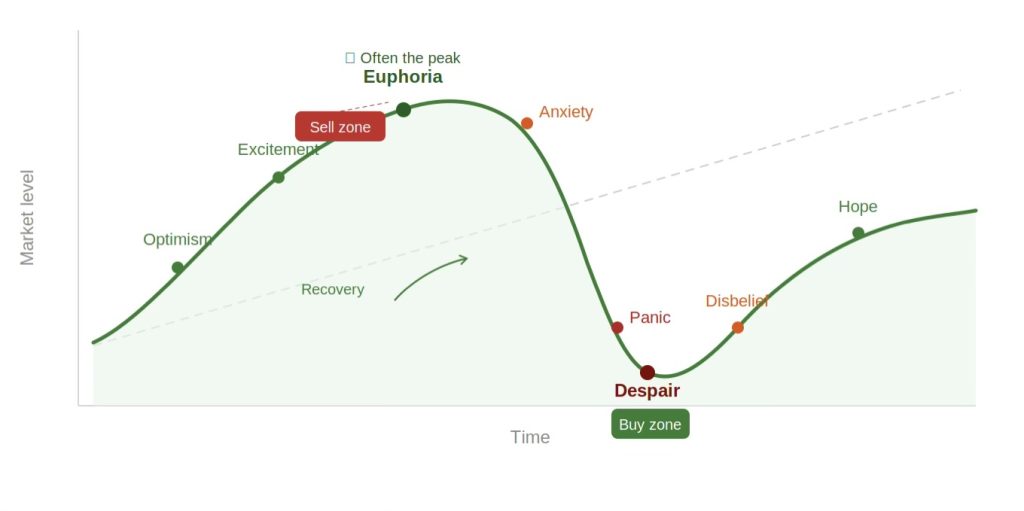
Whilst this may be an exaggeration, for many investors it reflects the reality of how emotions can impact decision-making — often leading to buying at the wrong time and selling at the wrong time.
Investors see sharp declines in their portfolios and recognise that markets may be offering value. However, recent losses can damage confidence, preventing them from acting rationally.
A well-structured portfolio provides reassurance — even during periods of volatility — and helps reduce emotional decision-making.
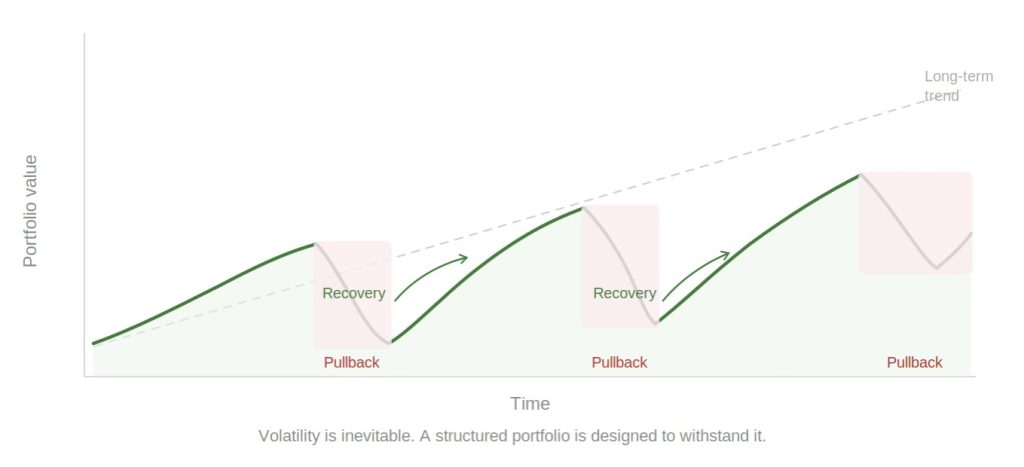
Understanding that in any portfolio’s lifetime there will be challenging periods is essential. Knowing how a portfolio is designed to withstand them allows investors to act calmly and sensibly.
Is diversification the key?
In short, the aim of diversification is to reduce the impact of market volatility on a portfolio. It ensures that exposure is not concentrated in one area that could significantly affect performance during a downturn.
It is common to encounter investors who either underestimate diversification or believe they are diversified when they are not. Diversification can be confusing, and questions such as “Am I diversified enough?” are frequently asked.
Diversification in a pullback
When properly diversified, a portfolio has a better chance of maintaining stability during volatile periods. Different sectors and asset classes do not always move in the same direction at the same time.
Recent market conditions have shown how certain sectors can be impacted by global factors such as interest rates, inflation, or geopolitical events — reinforcing the importance of spreading risk.
Looking back, sectors such as mining have experienced both strong growth and sharp declines depending on global demand, particularly from China. Some investors may have concentrated heavily in these areas, expecting recovery, without fully considering the broader economic picture. This kind of overexposure can significantly increase risk during downturns. Diversification helps protect against this.
What does a diversified portfolio look like?
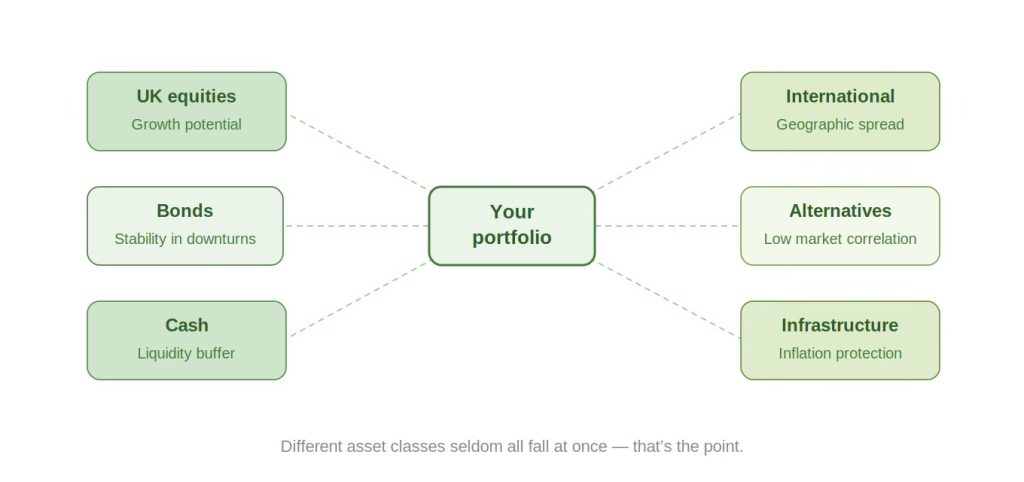
There is no perfect formula, but diversification typically involves spreading investments across different asset classes — for example, equities and bonds. The idea is that if one area of the portfolio underperforms, another may provide stability or offset losses.
The key is understanding what level of risk is appropriate and ensuring the portfolio reflects that. Avoid concentrating too heavily in one area that could cause significant losses or unnecessary stress.
To conclude
There are many ways to handle a market pullback. While extreme events may not happen frequently, market volatility is inevitable.
Whilst some investors may react emotionally, those with a structured approach will focus on re-aligning their portfolios and maintaining discipline. Each of the points above works together — portfolio structure, emotional control and diversification all play a role in long-term success.
Investing is not about avoiding volatility altogether, but about being prepared for it.
CSS Investments would be happy to help develop a strategy tailored to each client’s individual circumstances. As ever, during uncertain times it helps to have someone to talk to and rely on — please feel free to get in touch to see how we can support you.