Equity Research; Bond yields up as AI/government spending drains capital

Bond yields rise to 30 year highs
Rising bond yields are a live theme in Q3 2026, both as symptom and forward indicator. These pressures stem from capital drainage, a vacuum-like effect as cash is hoovered up to fund AI build outs and government spending. And as bond prices fall, selling waves are created.
The surprising thing is the context. Despite gilt yields at levels last seen in 1998, there is no perceptible crisis or precise trigger for the move. No precipitating event, no sterling crisis, no government collapse, no balance of payments crisis, no default. It is a ‘quiet crisis’ in that governments are aware of the problem but they realise shouting about it would be counterproductive.
In the US, France and Japan, there has been an uphill climb in bond yields suggesting markets are oversupplied. There is insufficient demand for the new primary issuance other than at higher yields.
Rising bond market tension is also occurring at a time of increased mistrust in the global financial order. Leaving aside the US initiated trade wars, this tension is spilling into the financial arena. I point to the somewhat cack-handed efforts by the US Treasury Secretary whose two market interventions to prop up the Japanese Yen and reduce long term US bond yields have been quickly reversed (i.e. seen as having failed).
In the case of the Yen intervention, which was weird in the first place, as the US Treasury should not be supporting overseas currencies, it has emerged the US Treasury used Euro to fund the Yen support without providing the ECB with prior notice or having a sign off. The ECB should have been informed that the Euro would be wobbling at the behest of the US Treasury.
A failed currency intervention can badly hit confidence making an existing problem worse. The motive for the Yen support appeared to be concern over potential Japanese sales of US Treasuries (which would hurt overseas demand for US bonds). However the sinking Yen remains unresolved. The intervention failed to tackle the bone of contention, that Japanese interest rates at 1% are too low and hikes in Japanese interest rates are needed to rescue the Yen. The US Treasury’s intervention has not changed the Bank of Japan’s mind.
The twist operation, notifying investors that the US Treasury would buy longer dated bonds (c. $4bn per month) funding it out of cash reserves and short term issuance was aimed at addressing the embarrassing reality of high 30 year yields, and more importantly sky high US mortgage rates (currently c. 6.9% for 30 year fixes). It is not quite the same as quantitative easing which can only be carried out by the US Federal Reserve. But the twist operation has not resulted in a drop in US Treasury long yields.
Whilst recent events have rattled, moving to specific causes, there are two leading actors and one supporting actor.
i) AI funding – a PriceWaterhouse Coopers report / Global Data Centre Outlook (2 September 2026) global AI infrastructure investment spending is forecast to hit US$31.6trn by 2050 with annual capital expenditure rising from $800bn p.a. to $1.8 trn p.a. by 2050.
This is due to the ongoing spending required at data centres, the reality of chip failure due to overheating/ life span / upgrade/ obsolescence with burn-out every c. 3 years. This occurs due to i) electromigration (electricity displacing interconnectors) i.e. silicon ageing ii) thermal cycling / solder fatigue – moving parts heat up and cool down at different speeds stressing joints (like aircraft metal fatigue) iii) capacitor ageing / degrade, their life halves every 10°C hotter (the Arrhenius relationship)– capacitors often fail before transistors or GPU.
A data centre is ‘a hybrid asset with a complicated cost/ risk profile’ says the PWC report and unlike other ‘infrastructure’ with front-loaded expenses. Even if the PWC projected numbers are high, and prone to variance given it spans a 25 year period, even if the democratic means still exists to slow down the data centre rollout, the 2026-2050 spending forecast is staggering, it appears to be c. 3x the total Allied expense on WW2 (c. $9trn over 5 years), albeit spread over 24 years.
The real issue is the borrowing requirement of i) hyperscalers (Amazon, Apple, Alphabet, Microsoft, Meta Platforms) ii) non hyperscaler capacity demand ( Taiwan Semiconductor, Samsung / manufacturing commitments/ non US investment iii) the broader supporting eco system, power, water plants build out required to power and cool data centres.
The table below shows the likely borrowing needs of Microsoft and Alphabet i.e. the pressures on operating cashflows of the 2 largest hyperscalers after factoring in other expenses such as i) dividends/ share buybacks ii) acquisitions iii) non AI capex investment. The reality is the large techs are adding a cost edifice that will require ongoing borrowing.
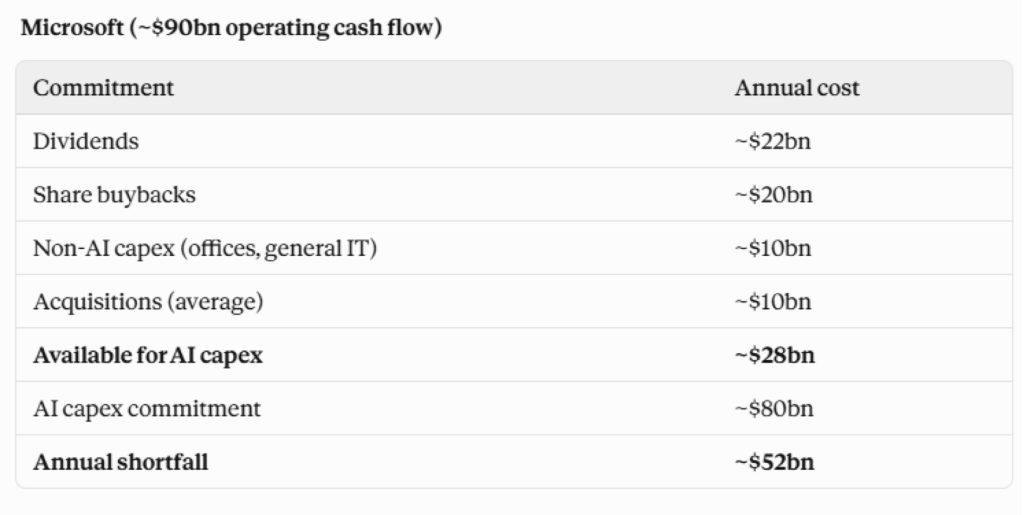
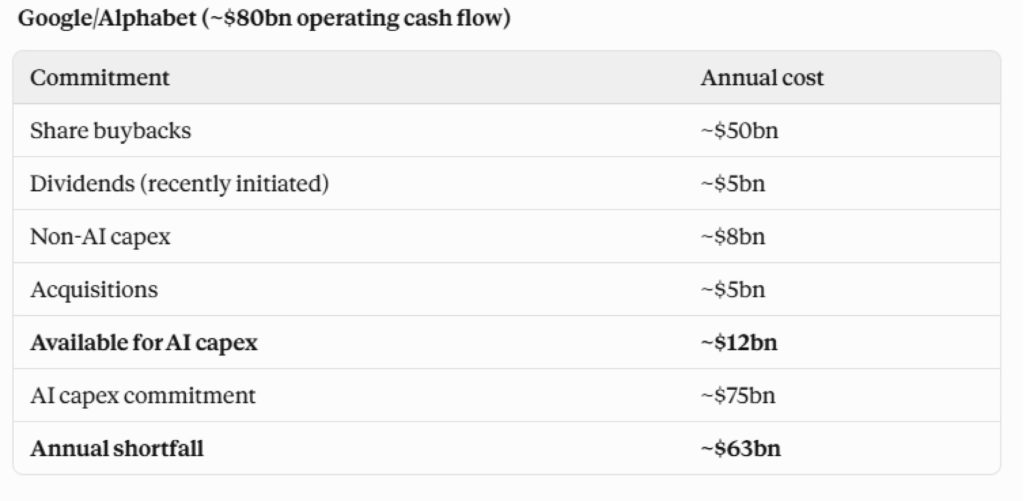
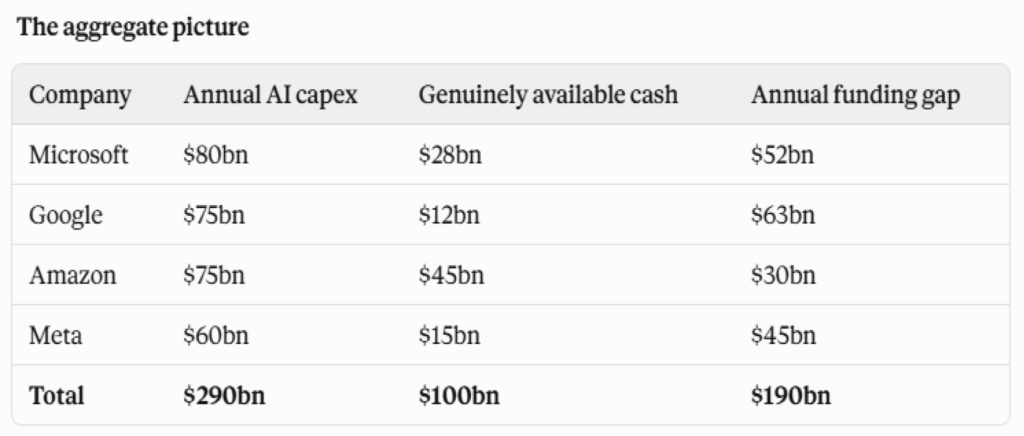
Source: CSS Investments
Over 5 years the hyperscaler funding gap looks like near to US$1tn assuming current levels of spending do not rise further. However this does not include the broader investment thought to be at least $50-$60bn p.a. This would suggest a c. $1.3tn of spending needs.
The issue is can capital markets absorb this new supply of bonds?
Possibly, but not without a significant impact on bond yields. This new bond supply amounts to a competitive threat to government bonds, a high yield alternative that it has not faced before.
ii) Annual Organisation for Economic Co-Operation & Development (OECD) government bond issuance, ie. net new bonds generated by the 38 OECD governments is c. $4trn p.a. of which the USA is $2trn of borrowing. Existing sovereign monetary debt is c. $160tn with an additional c. $59tn of corporate debt.
To put $160trn government debt into perspective, consider gold, the next most liquid tangible form of money. Total mined gold production in 2025 was 3,670 tons (World Gold Council data) worth c. $543bn (using $4600/ oz) – hence the government debt increase is 7.3x annual gold production. One reason why central banks have been adding to their gold reserves so quickly.
Western governments are facing increasing demands originating from the US Administration to increase defence spending (a very low economic multiplier investment) at a time of strained finances.
At what point is an inflexion point reached on government overspending? During the last Coalition/ Conservative government which ran from 2010 to 2024 the UK government debt rose from £1.05tn in May 2010 to £2.8trn in July 2024 – a near tripling of the UK debt in just 14 years. Yet at no point was government debt accumulation put to voters as a serious issue requiring a consensus.
The UK position exemplifies the alarming deterioration in many governments’ finances in the last 20 years. It is surprising that only one OECD country, Greece, has defaulted on its sovereign debt in the last 20 years.
Conversations about spiraling government debt in many countries are only now entering into political discourse. The argument is often presented that governments want to inflate away their debt. Quite possibly. The US, despite having the world’s largest debt and structural imbalances has yet to come up with a plan for debt reduction despite US mortgage rates of c. 7% which makes property purchase unaffordable for many.
iii) The supporting actor in the bond sell off is the recent geopolitical developments/ actual wars / trade wars/ unstable international relations/ all stressful issues that all have an inflationary impact for their duration. This breaks down into:-
- Trade fragmentation/ tariffs the US / China trade war is thought to have added c. 2% to tariff impacted goods but also triggered more ‘nearshoring’ i.e. the relocation of supplies nearer to home at higher cost curves fueling cost inflation.
- Energy market disruption – Middle East tensions, invasions, bombing campaigns and supply disruption is thought to have added a $10 – $15 / bbl risk premium to crude oil prices.
- Defence Spending – NATO moving from 2% to 3% of GDP on defence spending means an extra €200-€300bn of supplemental borrowing for NATO members.
- Critical materials premiums/ shipping / logistics – shipping costs have risen 40% on routes impacted by wars/ re-routing trade flows.
- Labour market tightening – the concern is the AI data centre build requires significant skilled construction labour at a time of high immigration restrictions hence high project costs.
Conclusion
Cash is being ‘drained’ into government lending and AI spending and becoming pricier. This ‘crowds out’ funding availability elsewhere including for individual borrowers. Capital markets are efficiently pricing rising cash demand. Bond markets are also wary of inflation risks, government profligacy, excessive IT spending and methods that could be used to inflate debt away.
The findings broadly corroborate a speech by Andrew Bailey Governor of the Bank of England at LSE on 4th September 2026. Bailey acknowledged the pressures on bond markets due to ageing populations, higher defence spending creating ‘very substantial structural challenges’.
Assuming rising bond yields continue how should investors react?
- Bonds – short term only – a rising yield curve impacts longer maturities far more- so keep the maturity very short i.e. 1-3 year spread and include floating rate notes (FRN).
- Gold – debt expansion is far more rapid than new gold output – gold looks well positioned and under-owned. If only 1% of bond holdings ($1.6tn) is shifted into gold, that new demand would amount to 3 years of output. Central bank purchases are also providing support.
- Equities- rising bond yields create competitive pressures for equities a major factor behind the October 1987 crash. Quite possibly the 1980’s inverse relationship is looser now, with other factors such as leverage more important. There could be a re-appraisal for equities if governments start raising corporate taxes to address budget shortfalls, after all companies don’t vote. Within equities high yielders are less impacted in this scenario.
- Property- rising bond yields / high mortgage rates have hit first time buyer/ investor demand. Property has sagged in recent years as investor returns have declined amidst tax and regulatory changes and broad investor reappraisal of investment merits. The numbers are not making sense in property anymore, with valuations vulnerable to more of the same, multi- year drift off that we have experienced since 2023.